What twenty years of building inside heavily regulated industries taught me about software, and where AI takes it next. Strong opinions, all of them earned the hard way.
AI has broken the economics that made businesses bend to their software. The companies that notice first will pull ahead.
July 2026
Ready Is a Moving Target
Government tech taught me how to manage risk. A 5-year sprint to an IPO taught me how to actually ship.
I came in when it was still scrappy, growing rapidly and when decisions got made over Slack, and I left after the IPO, when there were investors and analysts and a stock ticker attached to things I used to just go build. Five years at a startup is a long time in startup years. It's long enough to learn about how real rapid growth actually happens, and I picked up quite a few lessons along the way.
A key lesson is simply to treat execution as a hypothesis. You have to experiment faster than feels comfortable. Not recklessly, just faster.
Before my startup adventure, I spent years handling state government technology. In that life, I was used to timelines where it could take literally years before anything new was actually developed and deployed, especially when we were tackling full-scale migrations of massive, legacy systems. When you are dealing with decades-old infrastructure, the default assumption is that every single detail must be perfectly mapped out in a massive project plan before anyone makes a move.
But stepping into a fast-paced environment forced me to unlearn everything. What I ultimately discovered is that you can still experiment, even if you are attached to age-old code and clunky systems. You don't have to wait for a grand, multi-year migration to be complete just to test how users actually want to interact with a new application, workflow or process.
I learned to stop waiting for a plan to be perfectly airtight. Instead of spending three months internally polishing a guess about what a solution should look like, it was always better to spin up a rough prototype or a wireframe and put it in front of real users, and let their behavior tell us where our assumptions failed. 99% of the time we got something wrong. Getting comfortable with being wrong was hard. But I always learned something so that we could quickly pivot or improve the experience, which was a thousand times better than waiting for years just because it wasn't considered "finished" yet.
Small businesses can learn this. Big enterprises can learn this. Government can learn this. It isn't about moving recklessly fast on things that deserve care. It's about noticing which decisions are actually high stakes and which ones just feel that way because nobody's tried moving faster on them before. It's about being open to testing your ideas, getting feedback quickly and pivoting or improving on the original concept.
If you're sitting on an idea, waiting until it's ready, I get it. I spent years learning that ready is a moving target, and the only thing that actually moves it is doing the thing.
The Best Time to Build Is Right Now
AI can write the code. It can't tell you what's worth building.
For years, getting a real idea into the world meant waiting. You waited on a dedicated team, you waited on a budget, and you waited through months of runway just to see if your concept even made sense. The traditional blocks for building apps kept so many great ideas locked away.
That era is over. We are living in a rare moment where the gates have simply vanished - and anyone can build an app. What used to demand three months of cross-functional coordination can now be built in a single day, solo.
The real magic of this shift isn't just that we get to build more features, it's that we can finally learn at the speed of our own curiosity! The faster you can put a real, working product in front of people, the faster you get to the truth of what they actually need.
There is one critical thing that AI didn't make faster - clarity. AI tools can write your code and architect your databases, but they cannot give you judgment on the right thing to build. They can't sit with a customer, feel their frustration, and intuitively know what problem is actually worth solving. Speed without a clear sense of purpose just means you'll ship the wrong thing faster than ever before.
I've always been technical, but the friction between identifying a problem and handing someone a working solution is now zero. I don't need to wait on anyone to act, and neither do you.
Take mobillwatch.com, an app I built solo. It's a tracker that maps all 3,142 Missouri legislative bills from the last session into plain English, a watch list, dates and subscribable calendars. It's the kind of complex, bill-tracking software that trade associations pay thousands for, but I aimed it at the people who can't: small local chambers, school boards, nonprofits, and everyday citizens that want to follow what's happening at the capitol.
Going from a blank screen to a live, trusted domain with 3,403 pages took me exactly 36 hours, completely alone. There was no team, no funding, no vendor, and no CMS. The ability to build is no longer the bottleneck. The only differentiator left is finding a problem you care deeply about, and having the clarity to solve it.
If you've been sitting on an idea, waiting for the right budget, the right team, or the right permission - this is your sign. We've hit an incredible inflection point, the barriers are gone. Founders, product people, innovators, it's your time. The best time to build is right now.
The End of One-Size-Fits-All
AI has broken the economics that made businesses bend to their software. The companies that notice first will pull ahead.
Every enterprise software deal ends the same way. The vendor demos a product built for a thousand companies. The buyer signs. Then, quietly, the business starts bending: renaming its processes to match the vendor's vocabulary, adding steps because the workflow demands them, hiring people whose whole job is working around the system.
I've watched it for twenty years, up close. In state government, where teams reshaped how they worked around whatever their systems could handle. In insurance, where quoting a policy took ten minutes because ten minutes was what the platform allowed; it took Lean process work and a rebuilt portal to get it to three. In construction technology, where the workflows that actually made money (credit, insurance, logistics) lived outside the software entirely, in phone calls and PDFs. The software never quite fit, and the business always paid the difference.
We accepted this because the economics gave us no choice. Custom software was a luxury. Building something shaped to one company's actual workflow took years and millions, so we bought the closest thing off the shelf and absorbed the friction. One-size-fits-all was never a design philosophy. It was a cost constraint.
That constraint is collapsing.
AI has changed what a small team can build. The systems I drove to production in the last few years, an image-recognition tool that grew an equipment catalog twentyfold and a model that read live data off the machines to predict breakdowns, were software shaped to one company's equipment, one company's data, one company's day-to-day reality. None of it existed on a vendor's price list. All of it went live.
A caution, learned the Lean way: technology applied to a broken process just makes the mess move faster. The order still matters. Map the workflow. Take out the waste. Then build to what remains. AI lowers the cost of building. It does not lower the cost of building the wrong thing.
But when the process is sound, the old tradeoff is gone. You no longer choose between software that fits and software you can afford. The companies that see this early will stop contorting themselves around their vendors and start compounding: every workflow a little more their own, every system a little closer to how the work actually happens.
One-size-fits-all software had a good run. It was the sensible answer to a world where software was expensive to build. That world is ending.
The fit is the product now.
Recent Appearance
August 5, 2026 · Columbia, Missouri
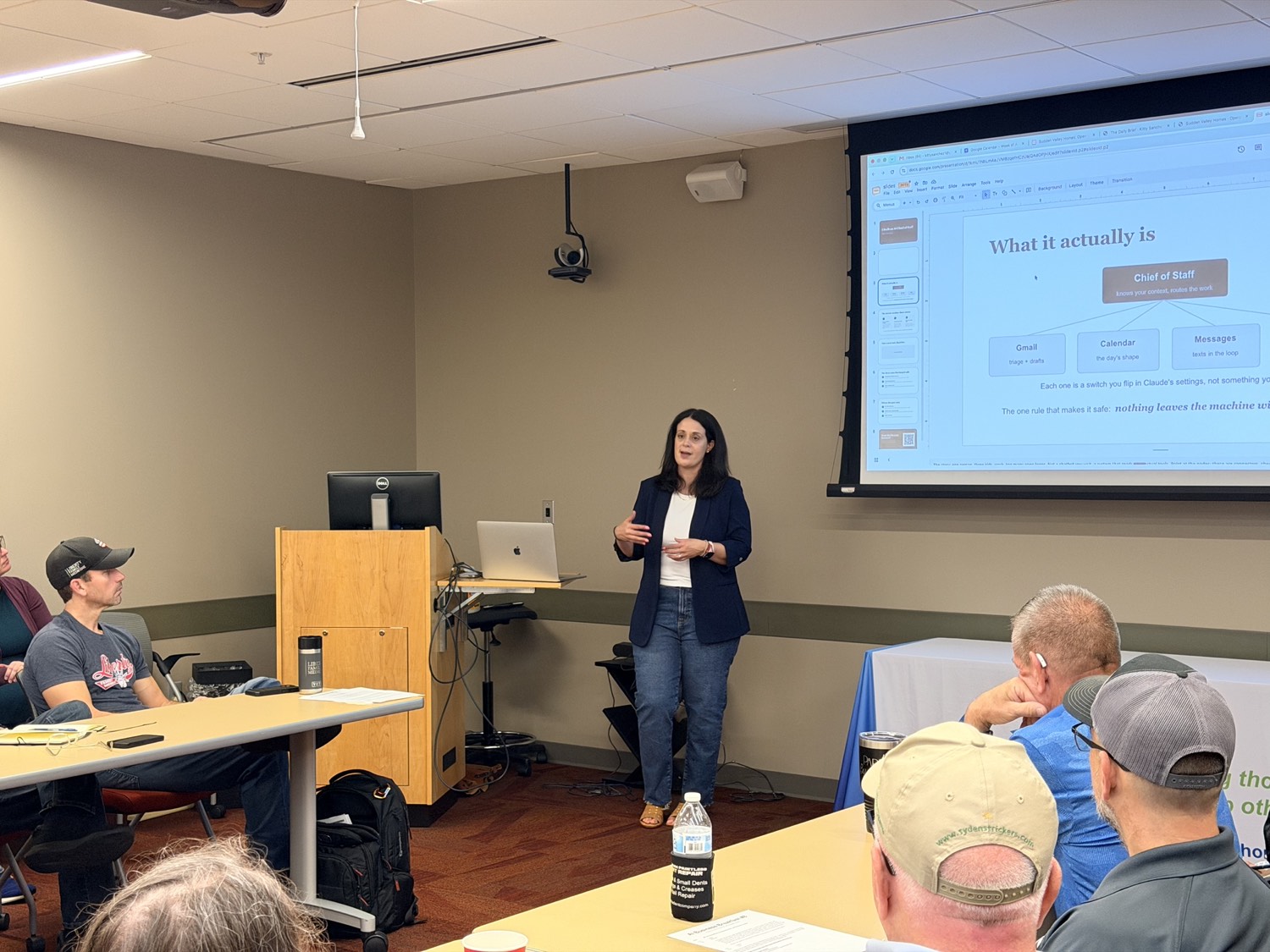
AI Business Breakfast #8
Guest speaker. Real questions, practical AI, real results: the room brought its worst recurring tasks and we built fixes on the spot.
Working through what an AI chief of staff actually is, and the one rule that makes it safe.
WhenAugust 5, 2026Delivered
WhereREDI Office500 E Walnut, Suite 103, Columbia, Missouri
FormatOne hourTalk, live demo, and build clinic
I built an AI chief of staff (you can too)A one-page brief that knows your calendar, your inbox, and your open loops. It triages messages, preps the day, drafts documents, and keeps track of what actually matters.
Three builds you can make this weekOne running live, then three no-code builds to start immediately, with the prompts and a 30-day plan to go with them.
Bring your worst taskThe recurring task each attendee hated most, fixed on the spot.
Get the 30-Day Plan →The handout from this talk. No code, about twenty minutes a day.
Speaking
I speak from the builder's side of the table: what actually happened, what it cost, and what held up once real people used it. Current topics:
Building a channel from nothingTaking a relationship-driven business online for the first time, and making the channel stick.
AI in traditional industriesImage recognition, predicting breakdowns, and the difference between a demo and a system that actually runs the business.
The end of one-size-fits-all softwareWhy software built for one business is suddenly affordable, and what companies should do about it.
Lean before codeFixing the process before you automate it.